Rooftop Package Units in Port St. John, FL
A rooftop package unit sits where few people ever see it, humming away above the ceiling of a store, restaurant, or office in Port St. John, FL. Inside that single steel cabinet live the compressor, condenser coil, evaporator coil, blower, and controls that would otherwise be split between an indoor and outdoor section. Everything the system needs to cool and heat a building is combined into one weatherproof enclosure, mounted on a curb and tied directly into the ductwork that drops through the roof deck. This all-in-one design is the reason package units dominate the light commercial landscape, and it is also why they call for a specific set of skills when the time comes to repair, maintain, or replace them.
How a Rooftop Package Unit Works and Why Businesses Choose It
The appeal of a rooftop package unit starts with its footprint. By placing the entire HVAC system on the roof, a building owner frees up valuable floor space, reduces indoor noise, and keeps the equipment out of reach of foot traffic and vandalism. In a climate like ours, where cooling runs hard for most of the year, this configuration also simplifies service access. A technician can work on the whole system from one location instead of coordinating between a mechanical room and an exterior pad.
Package units come in several arrangements. A gas/electric unit pairs electric cooling with a gas-fired heat exchanger, while a package heat pump reverses its refrigerant flow to provide both cooling and heating from the same compressor. Straight-cool models handle buildings where separate heating is not required or is supplied another way. Each type moves conditioned air through supply and return ducts that penetrate the roof curb, a raised frame that seals the opening and supports the weight of the cabinet. At ABC Air Conditioning & Heating Specialist Inc.™, we service all of these configurations across every major brand, because our technicians are trained to repair, replace, or maintain every major make and model of HVAC equipment.
Businesses throughout Port St. John rely on rooftop package units for a wide range of spaces. A few of the most common settings include:
- Retail storefronts: single units or paired systems that keep sales floors comfortable during long operating hours.
- Restaurants and quick-service kitchens: systems that work against high heat loads and demanding ventilation requirements.
- Small office buildings: multiple zoned units serving separate suites with independent thermostats.
- Warehouses and light industrial bays: larger-tonnage units moving substantial air volume through long duct runs.
- Medical and professional offices: units paired with careful filtration and humidity control for patient and client comfort.
Our Approach to Rooftop Repair and Diagnostics
When a rooftop package unit stops performing, the symptoms often look alike from the thermostat: warm air, short cycling, or a unit that simply will not start. The cause, however, can live in any of the integrated components. Our diagnostic process begins at the cabinet itself, where we confirm incoming voltage, inspect the contactor and capacitor, and verify that the compressor and condenser fan motor are drawing current within specification. Because a package unit combines so many parts in one place, a methodical sequence prevents us from chasing the wrong fault.
From there we move through the refrigerant circuit, checking suction and liquid line pressures against the manufacturer’s charging charts and measuring superheat and subcooling to confirm the charge is correct. A low charge points toward a leak that must be found and sealed rather than simply topped off. We also examine the evaporator and condenser coils for the airflow restrictions that are common on rooftops, where airborne dust, pollen, and debris settle directly onto the fins. On gas/electric models, we inspect the heat exchanger, igniter, and flame sensor, and on heat pump models we test the reversing valve and defrost control. Our goal is always to identify the root cause so the repair holds instead of returning in a matter of weeks.
Rooftop work also demands attention to the things around the equipment. The curb gasket, the condensate drain, and the economizer dampers all affect performance and can cause problems that mimic mechanical failure. A clogged condensate line can trip a safety switch and shut the unit down completely, while a stuck economizer can pull in hot outside air and overwhelm the cooling capacity. We treat these supporting systems as part of the unit, because to the building owner, a shutdown is a shutdown no matter where it starts.
Installation, Replacement, and Technical Specifications
Replacing a rooftop package unit is a coordinated effort that usually involves a crane, a crew, and careful planning to minimize downtime for the business below. Before the old unit comes off the curb, we confirm that the replacement matches the existing curb dimensions or we supply an adapter curb to bridge the difference. Matching the new cabinet to the duct openings, the electrical service, and the gas line is essential to a clean installation. Our large fleet and dedicated staff let us move quickly, and we regularly complete installations within two business days of an approved proposal.
Correct sizing drives everything about a successful package unit project. An oversized unit cools quickly but cycles on and off too often, which wastes energy and leaves humidity in the air. An undersized unit runs constantly and still cannot keep up on the hottest afternoons. We calculate the load based on square footage, insulation, window area, occupancy, and the internal heat produced by lighting and equipment, then select a unit with the appropriate tonnage and airflow. Several technical details guide this work:
- Cooling capacity: measured in tons, with one ton equal to twelve thousand BTUs per hour of heat removal.
- Efficiency ratings: SEER2 and EER values that describe how much cooling the unit delivers per unit of electricity consumed.
- Airflow volume: rated in cubic feet per minute, typically targeting around four hundred CFM per ton for proper coil performance.
- Heating input: for gas models, the BTU input of the burner and the efficiency of the heat exchanger.
- Electrical requirements: voltage, phase, and minimum circuit ampacity that must match the building’s service.
Getting these specifications right is the difference between a system that runs efficiently for years and one that struggles from the first season. ABC Air Conditioning & Heating Specialist Inc.™ specializes in residential and light commercial sales and service, and rooftop package units fall squarely within that light commercial focus. We pair the right equipment with the right installation so that Port St. John businesses get comfort without surprises on the utility bill.
Preventive Maintenance That Protects Your Investment
A rooftop package unit faces conditions that indoor equipment never sees. It bakes in direct sun, endures driving rain, and collects whatever the wind carries across the roof. Regular maintenance is the single most effective way to extend its service life and avoid the midday failures that disrupt business. We offer competitive preventive maintenance agreements in which our technicians visit twice per year to evaluate, clean, and tune your systems, restoring the efficiency that gradually slips away between visits.
During a maintenance visit we clean both coils, replace or clean filters, clear the condensate drain, inspect the belt and bearings where applicable, tighten electrical connections, and verify refrigerant charge and operating pressures. We also check the integrity of the roof curb seal and the condition of the cabinet panels, catching rust and gasket wear before they let water into the system. Catching a weak capacitor or a loose contactor in the spring is far less costly than a compressor failure in July.
Consumers across our service area have many choices when selecting an HVAC contractor, so we hold to strict hiring practices that put skilled, professional technicians in the field and in the office. We typically respond to service requests the same day they arrive, and an experienced technician is available for emergency calls 365 days a year, with 24 hour emergency service, so a down rooftop unit never means a long wait. Along with Port St. John, we proudly serve Oviedo, Orlando, Cocoa, Sanford, and surrounding areas and the surrounding communities, keeping businesses comfortable through every season while living up to our promise of Providing the Ideal Temperature.
*On select HVAC systems. Not valid with any other promotions. Limit one coupon per customer.

Based on approval. Not valid with any other promotions. Limit one coupon per customer.

Not valid with any other promotions. Limit one coupon per customer.

Not valid with any other promotions. Limit one coupon per customer.

Includes removal of the current unit. Our team of experts will install and test the new unit.
Not valid with any other promotions.Limit one coupon per customer.

Our technicians are comfortable working on all brands of A/C units.
Not valid with any other promotions. Limit one coupon per customer.
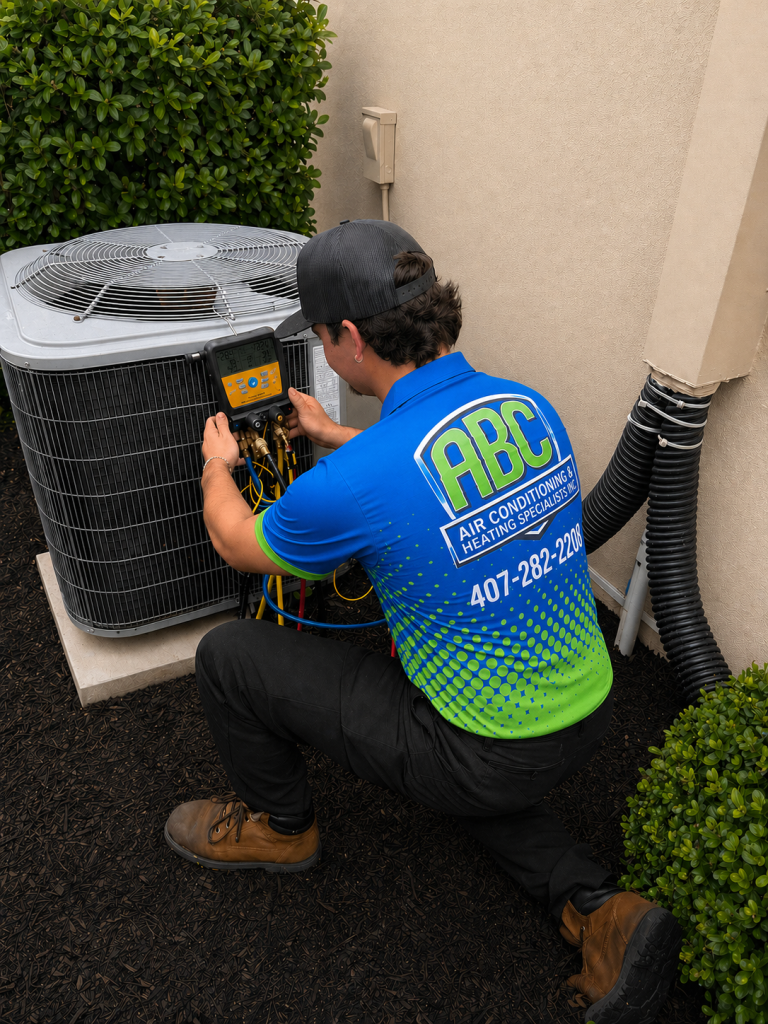
We will check your system’s coils, refrigerant levels, electrical components, filtration, and overall condition.
Discounted price for a “Service Call” is provided only when the customer pays for an additional repair. Not valid with any other promotions. Limit one coupon per customer.

Does not include new system replacement/installation or duct system replacement.
Not valid with any other promotions. Limit one coupon per customer.

Now Offering 0% Interest Financing
Keeping you and your family comfortable all year long.

Now Offering Free Estimates
Contact ABC Air Conditioning & Heating Specialist Inc.™ today!
- AC Installation in Port St. John, FL
- AC Repair in Port St. John, FL
- AC Replacement in Port St. John, FL
- AC Service in Port St. John, FL
- Commercial Duct Cleaning in Port St. John, FL
- Commercial HVAC in Port St. John, FL
- Commercial Split Systems in Port St. John, FL
- Ductless Mini Split Installation in Port St. John, FL
- Ductless Mini Split Repair in Port St. John, FL
- Ductless Mini Split Replacement in Port St. John, FL
- Ductless Mini Split Service in Port St. John, FL
- Heat Pump Installation in Port St. John, FL
- Heat Pump Repair in Port St. John, FL
- Heat Pump Replacement in Port St. John, FL
- Heat Pump Service in Port St. John, FL
- Heating Installation in Port St. John, FL
- Heating Repair in Port St. John, FL
- Heating Replacement in Port St. John, FL
- Heating Service in Port St. John, FL
- Indoor Air Quality in Port St. John, FL
- New Construction HVAC in Port St. John, FL
- Smart Thermostats in Port St. John, FL
- WiFi Thermostats in Port St. John, FL